
Well, I should have learnt by now that counting your chickens — or Kestrels, in this case — is never a good idea. Last year I celebrated the arrival of three chicks in the Block of Flats nest, only to see them unceremoniously whittled down to two, and then one. And of course, just a couple of weeks ago, I rushed to print to announce that a couple of similar birds were back to occupy the same nest.
After that last announcement, I went back to check on the amorous couple, noting with concern that the attacks by the Currawongs seemed intense and persistent. In addition, the female seemed to be spending a lot of time waiting on a branch for the male, whose appearances were brief and, to my mind, a little too tentative.


Although he also came in for some flak.
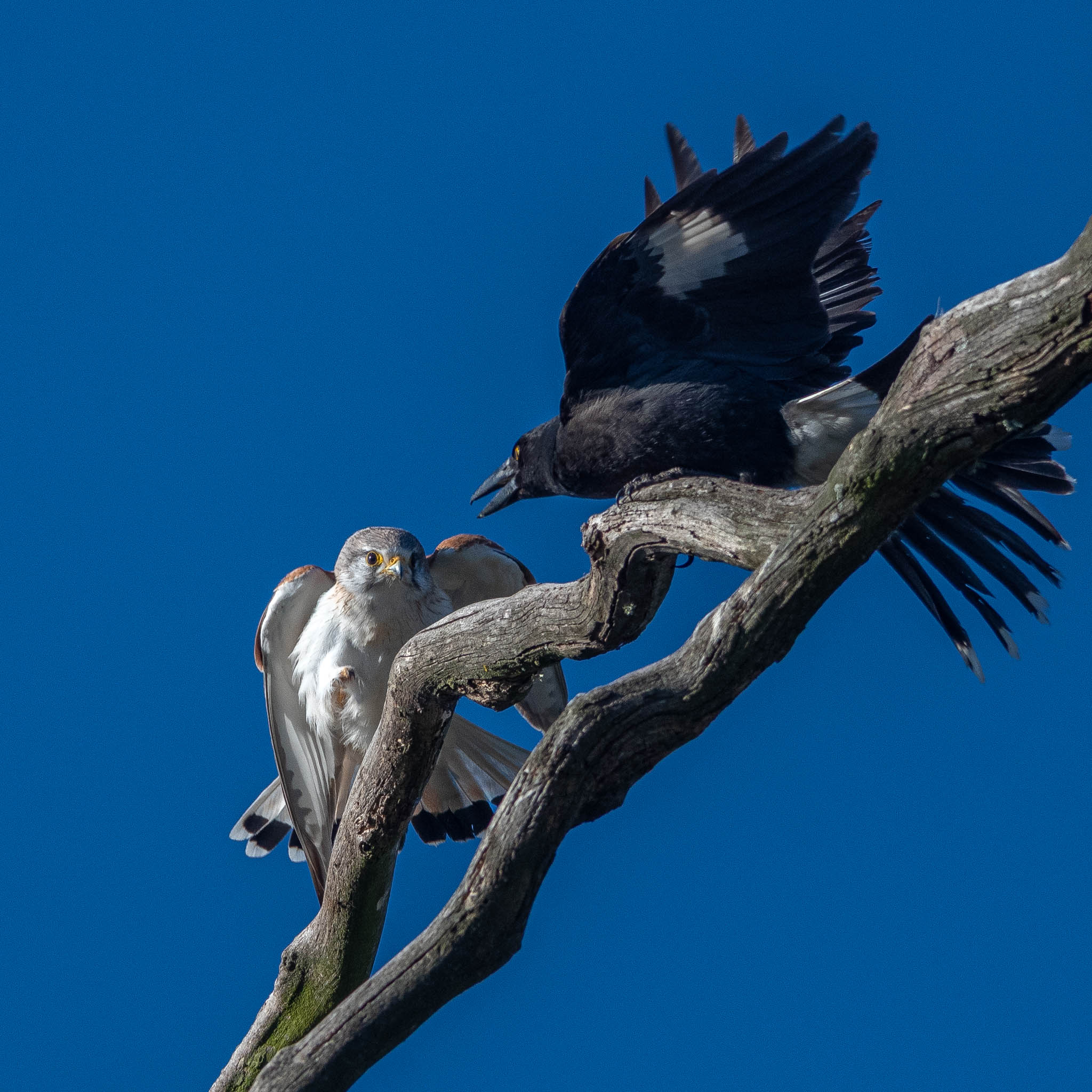

Then a few things happened — a dose of influenza B for me, a wave of cold, rainy weather, and the need for our car to spend some time in the shop. Finally, a chance arose to have another look at the nest — and there was no sign of the Kestrels. The Block of Flats was teeming with Starlings, Cockatoos and Galahs, but not a raptor was to be seen. I concluded that they had grown tired of Currawong harassment and had gone off to find a better spot. But more, I worried that it had been my presence, the clatter of my camera shutter, that had changed the Kestrels’ minds about settling here.
But recently I was on a different road on the hill, where Archie and go for I laughingly call ‘runs’, when I saw the familiar shape of a kestrel perching, rather unromantically, on a gantry at the waterworks where we park the car. It was nearly dark but seeing that shape was quite reassuring. It may have been one of the second pair I’d spotted not far from there.
On the next run, a week or so later in the same place, the ‘Eeek eeek eeek’ calls of a Kestrel rang out unmistakably just as we were about to leave. And there it was: perching on a dead tree with what appeared to be a hollow at the top.

By this time, it seemed to me, a Kestrel couple intending to procreate should have located a nest — and this looked like it might be it!
Two days later — today — we were back up there for another run. It was a glorious evening, clear and sunny, with Daylight Saving giving us a tranquil late sundown. Archie sprang out of the car and went looking for rabbits. While stretching rather gingerly (it’s been a while), I heard it: ‘eeek eeek eeek’ — the same distinctive cry. A Kestrel appeared close by on a different tree. It had something in its beak, and proceeded to duck into a hollow. Was it the male, feeding his mate as she incubated their eggs?
Spoiler alert: on examining the photos, it turned out that this was the female, the food she’d found was a large spider — a huntsman, I think — and she made short work of consuming it all by herself.

But the drama wasn’t over. We sat in the car, sweating attractively, for another fifteen minutes — and sure enough, there came the cry of the Kestrel again. The male was there, sitting on last week’s tree. And his lovely mate reappeared soon after, bearing another meal — this time a lizard.
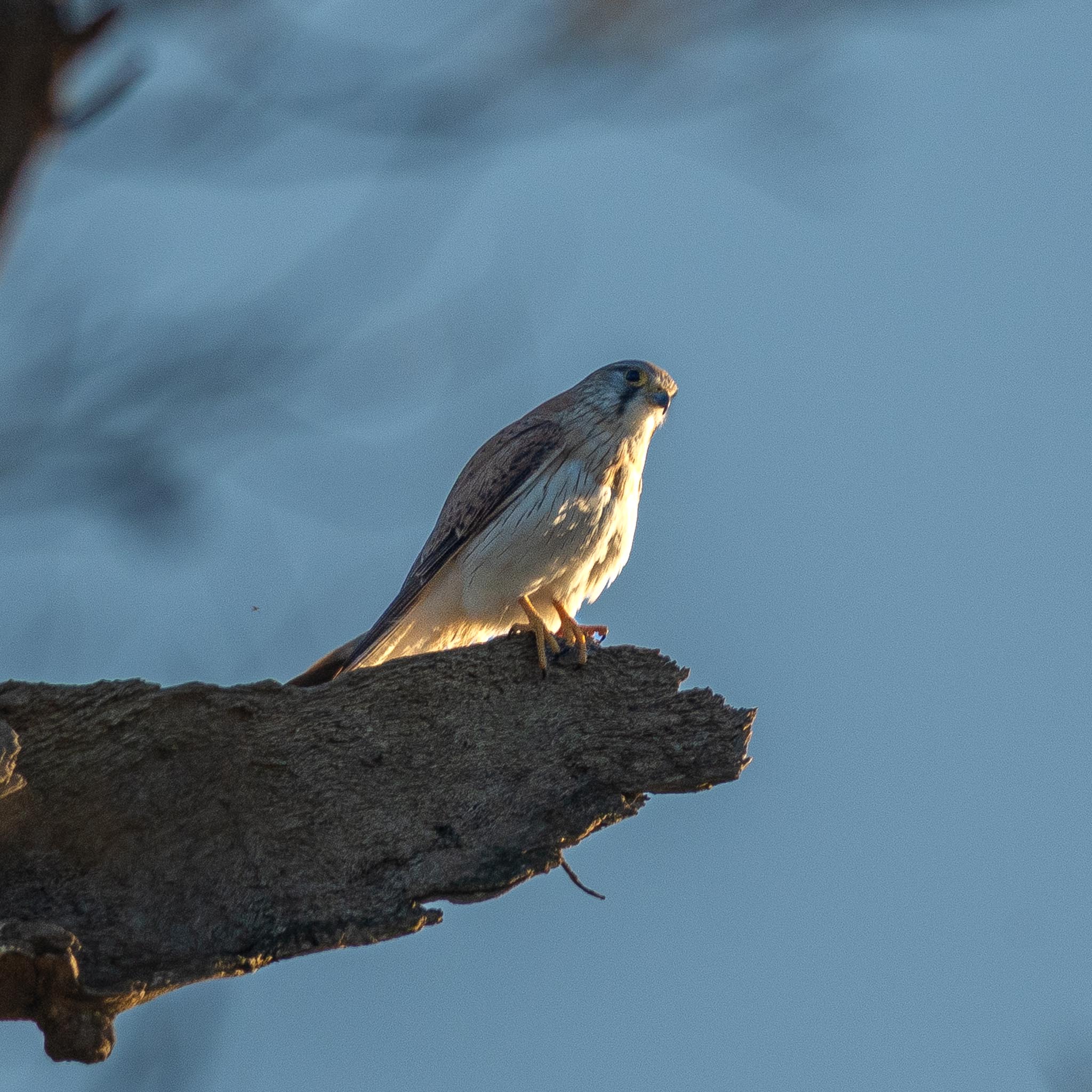
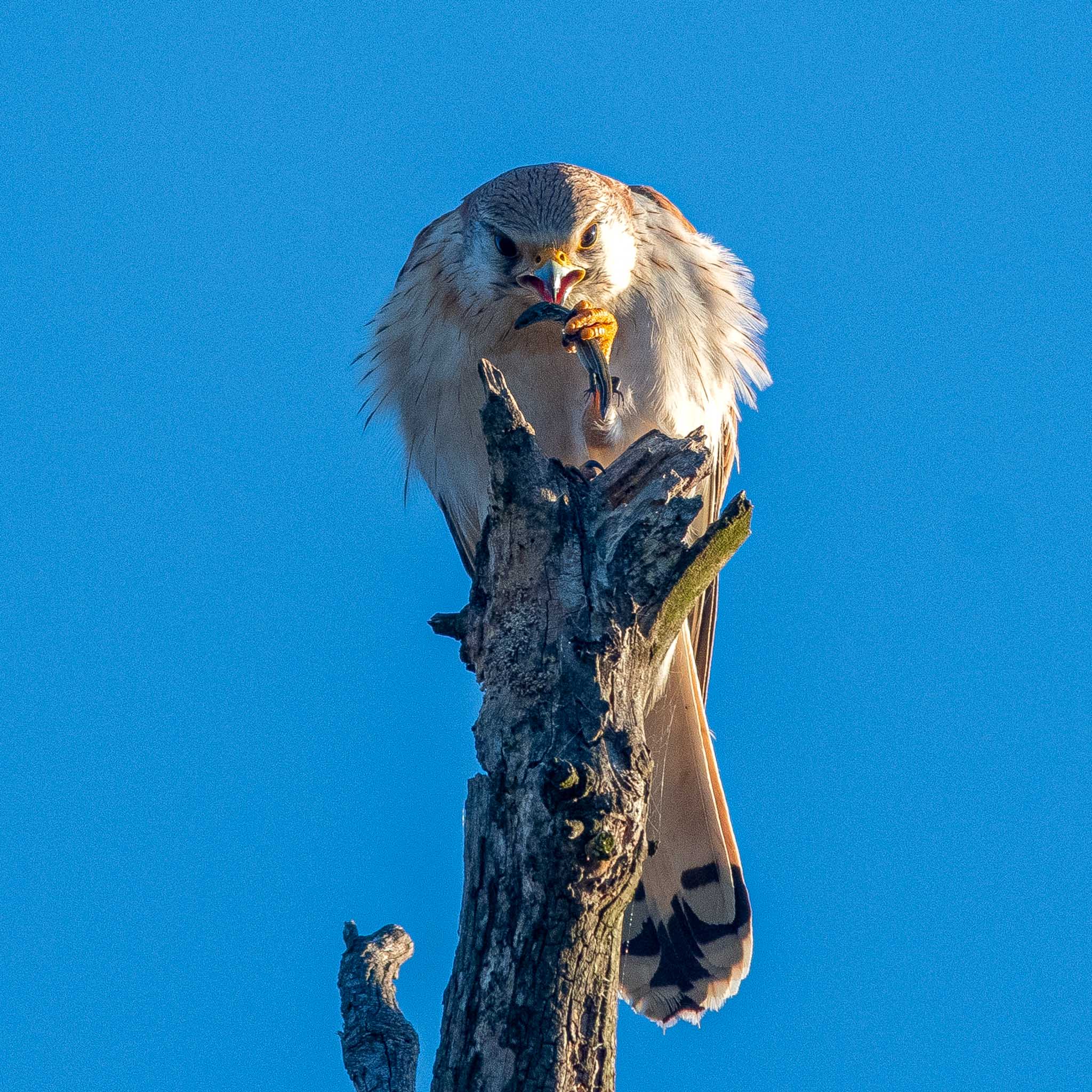
I began to wonder what value the male was adding — perhaps not fair, as he may have been the source of the lizard, but then I’ve started to nurture a certain animus against him, as if he’s not quite worthy of my girl. Yes, that’s lots of anthropomorphising, and totally wrong, but we all have our unconscious biases, don’t we?
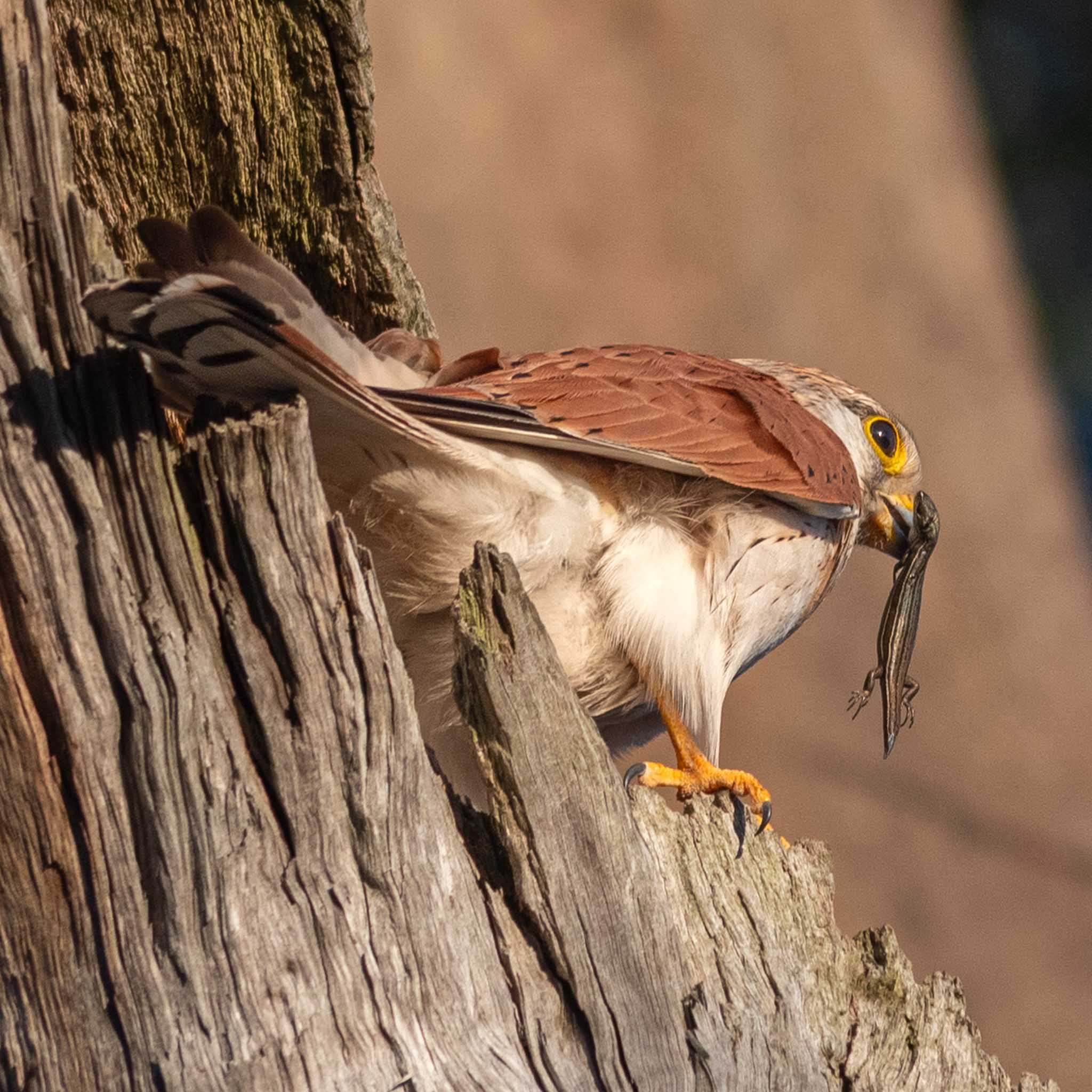
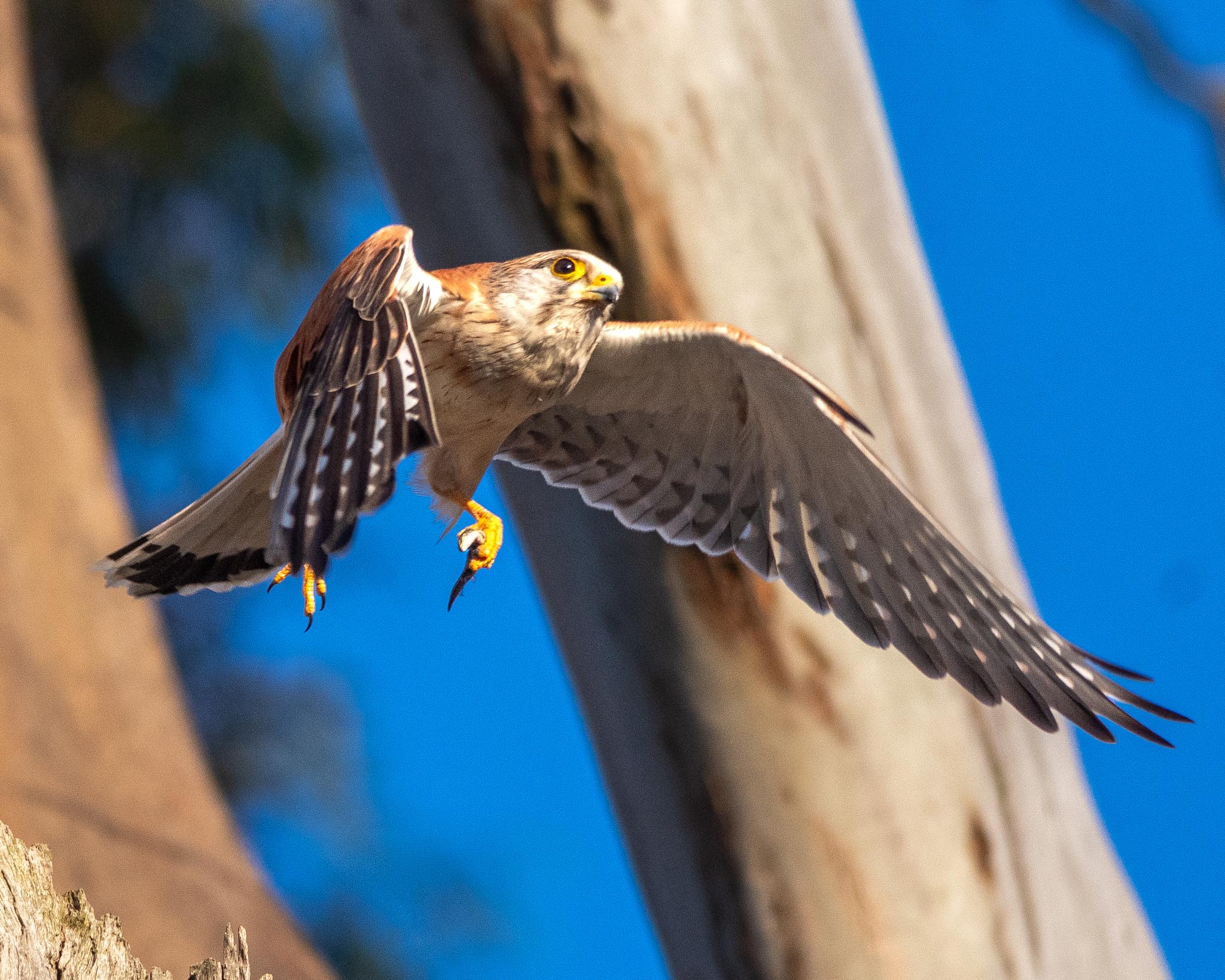
Anyway, she flew from perch to perch with her lizard, not stopping to finish this attractive morsel, so I thought perhaps it was time to go. Our presence and the clatter of the camera may have been spoiling her dinner.
But the story’s not over yet. Going back down the hill, past the paddocks where last year’s Kestrels spent a lot of time hunting and posing on fenceposts, there sat another kestrel! This was a male, possibly hanging on for one last bug or lizard before the sun set. I wondered if he had a mate, or whether he could pop up the road a short way and replace the fella I’d taken against.

It’s like a Kestrel soap opera, isn’t it? Or maybe that’s just the way I’m interpreting things that can’t really be understood in human terms at all. A spider for dinner kind of underlines that fact, I reckon.
You must be logged in to post a comment.